
A-Z OF THE PARLIAMENTARY ARCHIVES
AN ODYSSEY

A: Acts
We kick off proceedings with an Act. Not a simple procedure when there are thousands of enacted scrolls and parchments dating from 1497. Attainder Acts that historically led to ‘judicial execution’ always hold a particular fascination. As do the Jacobite’s hence our choice of the 1715 Earl of Mar Attainder.
B: Charles Barry
If it was decided to commission a TV show on Parliamentary Icons an episode would have to be devoted to 19th Century architect Charles Barry .His gothic designs for the Palace of Westminster rebuilding project after the 1834 fire left no stone unturned and are a standout in the collections.
C: CONSERVATION
Archives are reliant on the diligent expertise of its conservation and collection care teams. With records dating back to the 15th Century our conservators ensure if selected items are accessible to view. Once a year we devote on social media a themed week peeking behind the scenes in their studio.
D: KING CHARLES I DEATH WARRANT
Iconic is a term that can be somewhat overplayed. However, the 1649 King Charles I Death Warrant certainly falls into that fabled category. A supremely evocative piece of British history bearing the signatures and seals of the fifty-nine Commissioners aka the ‘regicides’ who fatally passed judgment on the vanquished monarch.
E: EXHIBITIONS
Westminster Hall has hosted several Parliamentary Archives exhibitions over the years. The most recent of which was the popular Spectacle and Ceremony that marked the bicentennial of King George IV’s famously extravagant Coronation Banquet. It was opened to the public in 2021 after the lifting of Covid public access restrictions.
F: HARRY FURNISS CARTOONS
Welcome to the wonderful world of Harry Furniss who was the undoubted star of the late Victorian satirical cartoon scene. His surreal take on political shenanigans become a must-see in Punch Magazine and then seized centre-stage in his own publication Lika Joka. Westminster’s finest weren’t safe from Furniss’s mischievous illustrations.
G: GUNPOWDER PLOT
Remember, Remember the Fifth of November! Guy Fawkes, Robert Catesby, and the rest are well accounted for within our collections. Less renowned is the second Gunpowder Plot that surfaced in 1690. An anonymous letter was read out to the Lord’s chamber warning of a fresh conspiracy along the same lines.
H: HANSARD
Is there anything as dependable for political research than Hansard debates. Covering the whole spectrum of chamber discourse in both Houses since 1803. For a prime example of great oratory retained in the series wartime Winston Churchill is a solid bet especially his speeches given in the summer of 1940.
I: INTERREGNUM
Oh no he didn’t… Basking in the glory of winning the English Civil War & seizing the country’s reins Oliver Cromwell began the Interregnum period with a vengeance. As the March 1649 House of Commons Journal referenced his unprecedented abolition of both the monarchy and the House of Lords – Boom!
J: JOURNALS
Commons Journals miraculously survived the ‘tally stick fire’ of October 1834 that barring a few exceptions destroyed the Parliament building. Thus, we can still access the original Elizabethan Journal that noted Queen Elizabeth I celebrated ‘Rebuke’ purposely aimed at a fractious section of MPs who’d voiced concerns regarding her governance.
K: KINGS
So many Kings so little time. Ignoring Tudors and Stuarts we opted for a Plantagenet. To be precise Leicester’s favourite son King Richard III whose monarchical tenure ended abruptly at the Battle of Bosworth Field. Anything he rubber stamped legislatively can be found in the printed Statutes of the Realm.
L: LLOYD GEORGE
As Personal Papers go Lloyd George’s is top of the pops. A vastly extensive collection encompassing the Welshman’s amazing life and times that directly influenced huge world events and domestic social change. His greatest moment is arguably the tour-de-force 1909 People’s Budget which lasted four hours and required prompted notes.
M: MICROFILM MACHINES
For those of certain vintage using a microfilm machine could make you momentarily feel like an esteemed historian. Its very difficult not to get overly nostalgic about this heavy-duty research aid that dominated the pre-digital landscape. Honourable mention also to the rapid spooling noise when the finished reel rewound itself.
N: NASEBY LETTERS
Nothing encapsulates the intrigue of the English Civil War more than the 1645 Naseby Letters .The secret correspondence of King Charles I abandoned as he fled defeat on the battlefield only to be discovered by Sir Thomas Fairfax and published by Parliament heaping further misery on the beleaguered Royalist cause.
O: OIL SLICK SPECIMEN
In May 1978 oil was washed up on a Lowestoft beach that emanated from the Eleni V tanker that had sunk forty years earlier. A Select Committee was set up to investigate and a small specimen was presented to them that was part of the evidence deposited to the Archives.
P: PARLIAMENTARIANS
The late Victorian era saw the emergence of the ‘personality’ Parliamentarian known throughout the land. They were captured for sepia tinted posterity in numerous photograph albums that rather inadvertently showcased some tremendous moustaches and ‘mutton chops’ that well over a century on comically inspired our annual ‘Movember’ social media coverage.
Q: QUEENS
Short lived though it proved to be the July 1553 nine-day reign of the mythical Lady Jane Grey still captures the imagination. A not so forgotten Tudor Queen whose ominous incarceration in the Tower of London and execution the following year can be time-lined in the Journals of the House.

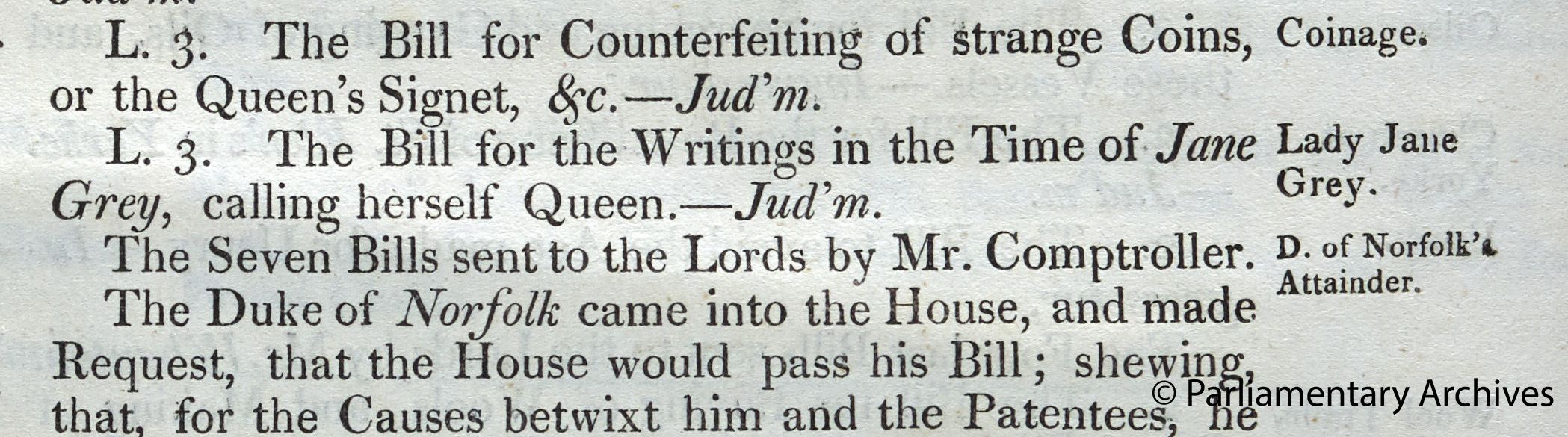
Queen Lady Jane Grey Journal Extract, 1553, Parliamentary Archives, HC/CL/JO/2/1
Queen Lady Jane Grey Journal Extract, 1553, Parliamentary Archives, HC/CL/JO/2/1
R: RAILWAY PLANS
You don’t have to be a railway enthusiast to appreciate the sheer majesty of our comprehensive railway plan collections that chronicle the birth of the industrial revolution and beyond. Spread across the UK & Ireland these incredibly intricate drawings display landmarks that remain familiar to all including St Pancras Station.
S: STONE PHOTOGRAPHS
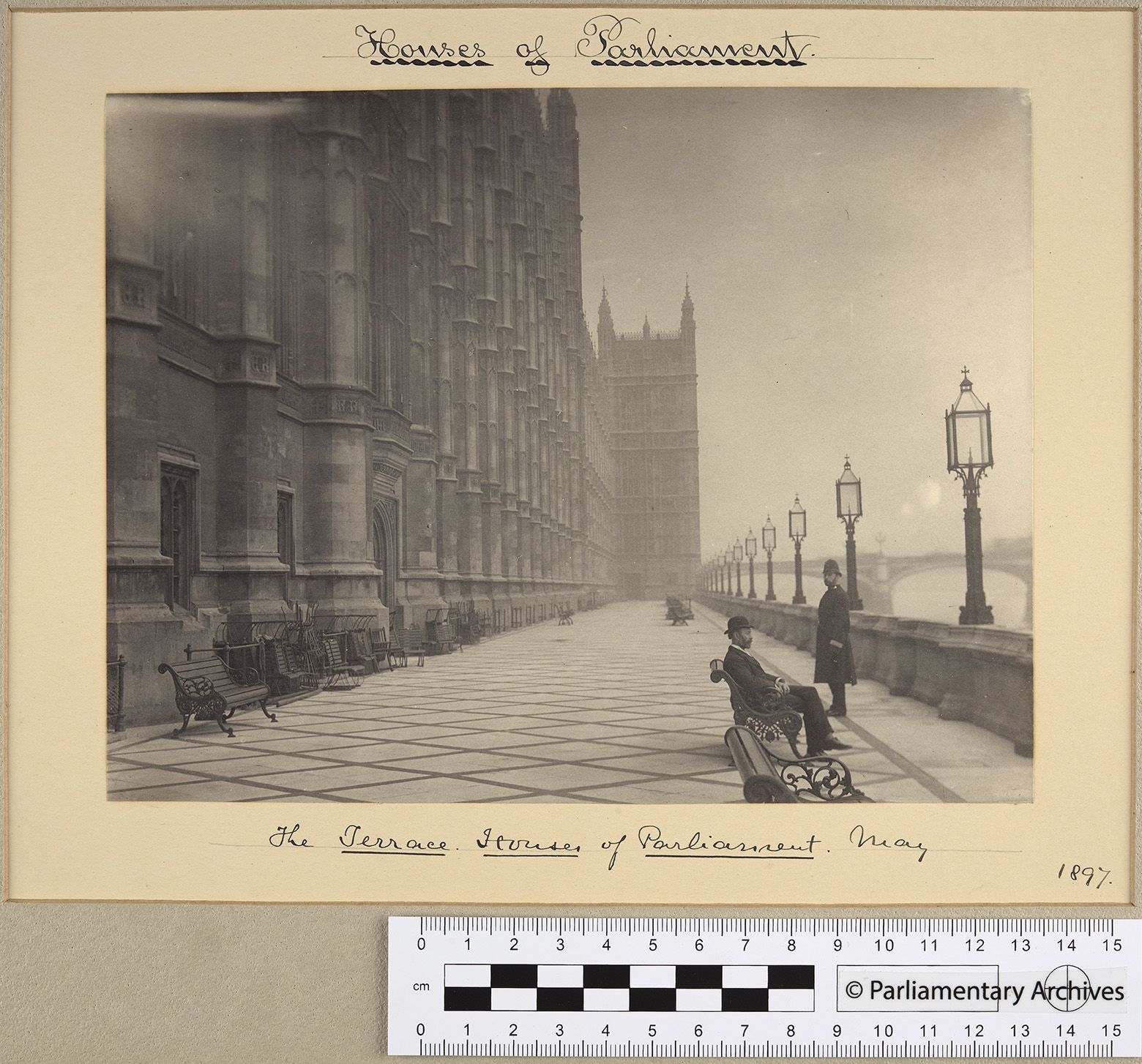
Benjamin Stone’s Westminster legacy is centred not on his political achievements but on the innovative photographs he took in the turn of the 20th Century around the Palace of Westminster especially on the Commons Terrace that faces onto the Thames. His reputation led him to be used for royal engagements.
T: TRACEY GRAVESTONE
Let’s get a wee bit scared as we unveil the creepiest item in the Archive. Introducing the dubiously fragmented Tracey Gravestone. Submitted to the House of Lords supporting an 1845 Peerage Claim tabled by James Tracey. Questioned for authenticity from the outset the hopeful claimant died before a final verdict.
U: UNIVERSAL SUFFRAGE
Suffrage is a universal theme that resonates through our collections from Simon De Montfort to Suffragettes. The 19th Century Chartist Movement paved the way for electoral reform and their programme for action is best highlighted by a petition sent to the Commons by Gloucestershire manufacturers calling for ‘vote by ballot’.
V: VICTORIA TOWER
Joyfully described as a 'trumpet blast from the Victorian age' the Victoria Tower Record Repository remains a symbolic representation of ‘History, Parliament, and Culture’. The words of former Leader of the House, Lord Hailsham who acted as Master of Ceremonies at the Tower’s reopening in 1963 to celebrate its restoration.
W: WOLFENDEN REPORT
Homosexuality was not decriminalised in England and Wales until the passing of the 1967 Sexual Offences Act. This ground-breaking piece of legislation wouldn’t have reached the statute book at that juncture without recommendations made by John Wolfenden’s Committee ten years previous. It’s considered a seminal document in UK LGBTQ+ history.
X: BALLOT PAPER
X truly marks the spot when elections occur, and essential ballot papers need marking off. Ignoring any modern trends, the layout of a standard polling station is not too dissimilar to the cartoons produced in the days of Bannerman, Balfour etc of men in top hats dutifully placing their votes.
Y: HOUSE OF COMMONS YACHT CLUB
Politics can be quite stressful so it’s good to have an outlet away from the rigours of daily business. Sir Reginald Bennett formed the House of Commons Yacht Club in the 1950s organising competitions such as The Old World v The New World Challenge Cup in the Isle of Wight.
Z: JOHN Z BELL (PRIZE CARTOONS)
Truth be told the letter Z was a real headscratcher… Then we remembered that Cardinal Bourchier and the Dowager Queen of Edward IV one of the 1843 Parliament Prize Cartoon winners was drawn by artist John Zephaniah Bell. Sadly, his prized work wasn’t taken up as a Parliament fresco installation.
CONCLUSION
Homer wrote in The Odyssey ‘There is a time for many words, and there is also time for sleep’ as our A-Z comes to an end. With no hint of embarrassment, I’d like to think it’s a love letter of twenty-six sonnets to our Archives and all it stands for.
You can learn more about our collections from our Twitter @UKParlArchives and Facebook.
We have a selection of online displays including:
Succession: Queens that ruled
Spectacle & Ceremony: Coronation Banquets & Westminster Hall
Parliament & The Falklands Conflict
Tudor Acts
Holidays in the Collection
 Built with Shorthand